People
Meet the Dockers: Joanna Dong
Joanna Dong's journey has taken her from international arts projects to exploring the rich food and cultural heritage of the Royal Docks. Since moving to the area in 2013, she has worked on a range of community projects, including FeastFest and the upcoming Royal Docks Food History Walking Trail.
In this edition of Meet the Dockers, Joanna reflects on finding a home in the Royal Docks, the local stories that have shaped her work, and what keeps drawing her back to community-led projects.
You moved to the Royal Docks in 2013. What brought you here, and what has kept you connected to the area since?
It was entirely practical at first. I needed somewhere affordable to live, and my work meant I was travelling for roughly half the year, so coming home was mostly just coming back to sleep.
The pandemic changed everything. When I was finally grounded here and forced to explore on foot, I started discovering something extraordinary. This is a landscape carrying an almost overwhelming density of unprocessed history. The former docks, the warehouses, and the industrial infrastructure all bear traces of a global trade network that helped shape modern Britain.
That historical weight, combined with the cultural diversity of the communities who live here now, made me want to put my skills to use. The Royal Docks kept presenting me with questions I felt compelled to pursue.
Early in your career, you were creating work internationally through Performance Infinity. What kind of work were you making then?
Performance Infinity was founded to facilitate genuine cultural exchange between the West and East. The work that most defined that period was the Mandarin-language War Horse, a co-production between the National Theatre of Great Britain and the National Theatre of China, where I worked as Assistant Producer from 2013 to 2018.
We also developed the Edinburgh Taiwan Seasons and a joint celebration of Shakespeare and Tang Xianzu. Over time, we worked with venues and festivals across China and beyond, collaborating with hundreds of artists from more than twenty countries.
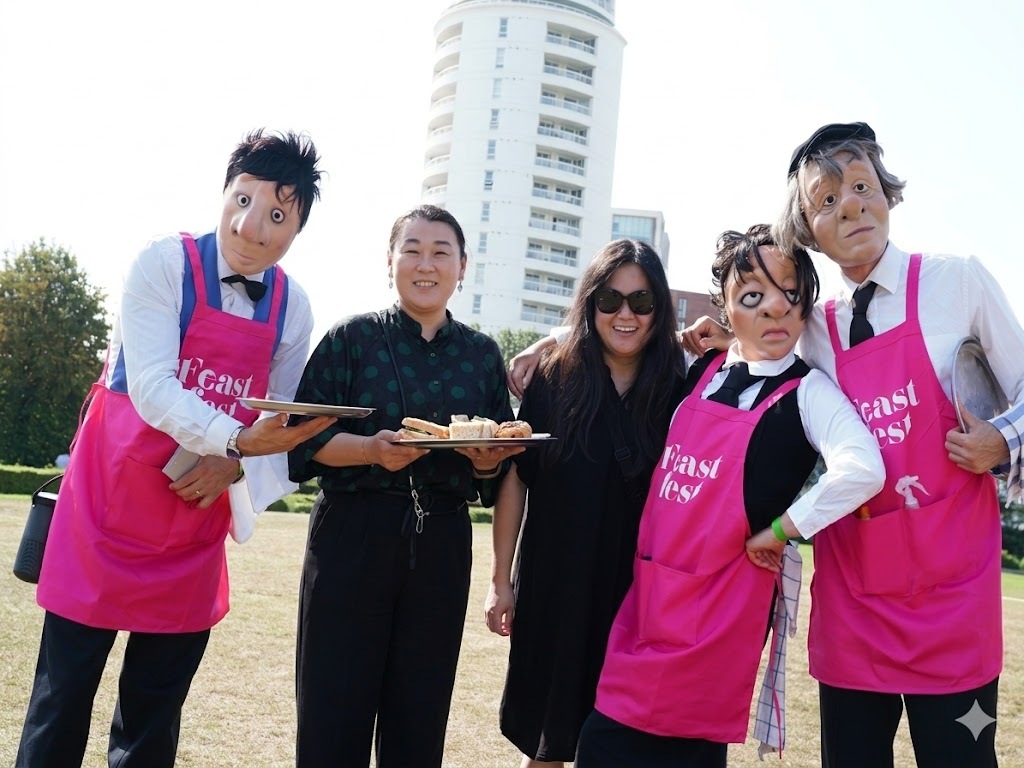
Joanna Dong with performers and participants at FeastFest 2023, a community food and culture event in the Royal Docks
During the pandemic, your focus shifted toward the local area. What sparked your interest in the Royal Docks' history and communities?
The pandemic forced me to confront what my practice was for and where it was rooted. There was no work at first, so I volunteered locally, helping with food deliveries and vaccine programmes. That was when I started seeing my neighbours differently.
I even started a vegetarian Chinese takeaway with a food anthropology scholar, which eventually closed, but confirmed something important. Theatre and food are the two things I care about most deeply.
When I began researching the Royal Docks, I realised it had been one of the world's great food import hubs. The scale of that history, and how little it is recognised today, felt like a sign. Somehow, theatre and food were going to meet here and grow into something I had not yet imagined.
You took part in Open City's Golden Key Academy, a guide training programme that helps people share local stories through walking tours. You went on to develop a walking tour of your own. What is it about?
The Golden Key Academy was formative because it placed local knowledge in the hands of residents. The walking tour I developed traces the Royal Docks as a food landscape, following how goods moved through the area and connecting that to the stories of workers and migrant communities.
At first, it focused more on architecture, but over time it grew into deeper questions about heritage, identity and who has the authority to define them. Those themes also connect with my PhD research at UCL Bartlett School of Sustainable Construction, which explores sustainable urban redevelopment and community co-creation.
That led to the creation of FeastFest. What makes it special?
FeastFest came from the idea that food is one of the most accessible ways into conversations about history, identity and belonging. In a place as culturally diverse as the Royal Docks, it creates a natural space for exchange.
The Royal Docks is also changing at extraordinary speed. New developments, new residents, new infrastructure — and with that, a real urgency to capture what is already here before it is lost or overwritten. Community voice and cultural identity need to be cultivated now, not later.
I have deliberately kept it rooted here. The challenge is ensuring that communities are not just participants, but active owners in how it develops. With time, I believe it can become a meaningful example of community-led cultural work.
What can people expect from your upcoming projects?
The Royal Docks Food History Walking Trail will be a self-guided route connecting key sites across the area, drawing on research and oral histories to present a different perspective on the Docks. This September, we are leading a guided version of the trail as part of the Open House Festival – a demonstration of the route, but also an invitation. The ambition is for local people to take ownership and lead it themselves in the near future.
Last Supper 1981 is a more immersive project using food and performance to explore a specific moment in the area's history. Both projects ask the same question: what does it mean to inherit a place, and what responsibilities come with it?
From this October, FeastFest will also have a permanent home in Newham — a space to make work, gather communities and collaborate with a wider circle of artists and local people. We will be making a further announcement soon.
Find out more
To learn more about Joanna's work, visit FeastFest, find out more about the Royal Docks Food History Walking Trail, read about her research at UCL Bartlett School of Sustainable Construction, and follow @feastfestlondon on Instagram for the latest updates.