People
Meet the Dockers: Gaurab Thakali
As part of our Meet the Dockers series, we spoke to London-based artist Gaurab Thakali, whose work explores the people, places and everyday moments that shape life in the Royal Docks.
Working across illustration, printmaking, murals and animation, Gaurab brings a strong sense of community and observation to his practice. For his new mural at Thames Barrier Park, commissioned by the Royal Docks Team, he draws on both his own connection to the area and insights gathered through workshops with local residents and students, creating a piece rooted in shared experience and a sense of belonging.
Thames Barrier Park is part of your daily life, from your studio overlooking the park to cycling and playing football there. What does this place mean to you, and how has that connection shaped the mural?
I’ve always seen the area as a family friendly space with lots of young people as well as parents and grandparents. It’s been a welcoming place for the local people to enjoy nature in a large green space by the river Thames. It provides a respite and calming atmosphere in the busyness of everyday life and work. Somewhere where everyone can come to relax and enjoy a communal experience. That for me had a big influence in shaping the mural which celebrates the community and our connection with the nature that is found in Thames Barrier Park.
What excites you most about creating a permanent piece of public art in a space you know so well?
I believe having an insight into the area is so important when creating a piece of public art, and I feel lucky to have that with my close link to the area. It’s the connection with the area and understanding the local community that makes it exciting, as well as engaging with the local people through the mono-printing workshops. I personally found it very insightful, knowing their views and thoughts on how they would like to be represented in a public piece of art. It is inspiring to create a piece of work that will have a lasting impact on the local community, where we can brighten up areas and make it a welcoming space.
Your work spans illustration, printmaking, murals and animation, often drawing on cultural references, music and nature. How would you describe your artistic approach, and how will that come through in the Thames Barrier Park mural?
I have always believed in public art projects and my work has been about focusing on people, our surroundings and focussing on the nuances of everyday life. With that in mind I approach a project like this with my knowledge and meticulous research into the area and the local community which then informs the final outcome, in regards to the composition, colours and content within the artwork.
This project has brought together students, residents and local partners. How important is that collaboration to your work?
It’s been a great experience to have collaborated with the students at Oasis Academy Silvertown, residents, visitors and local partners such as With Milk cafe. Their input and insight into the process of creating this piece of work has given the artwork a new dimension. During the mono-printing workshops, I had the opportunity to pick their brains in understanding their experience of living in the area and what the park really means to them. It was also important for me to share my experience and skillset working as a muralist and illustrator. It felt like a great way to connect and share knowledge and learn a thing or two about each other.
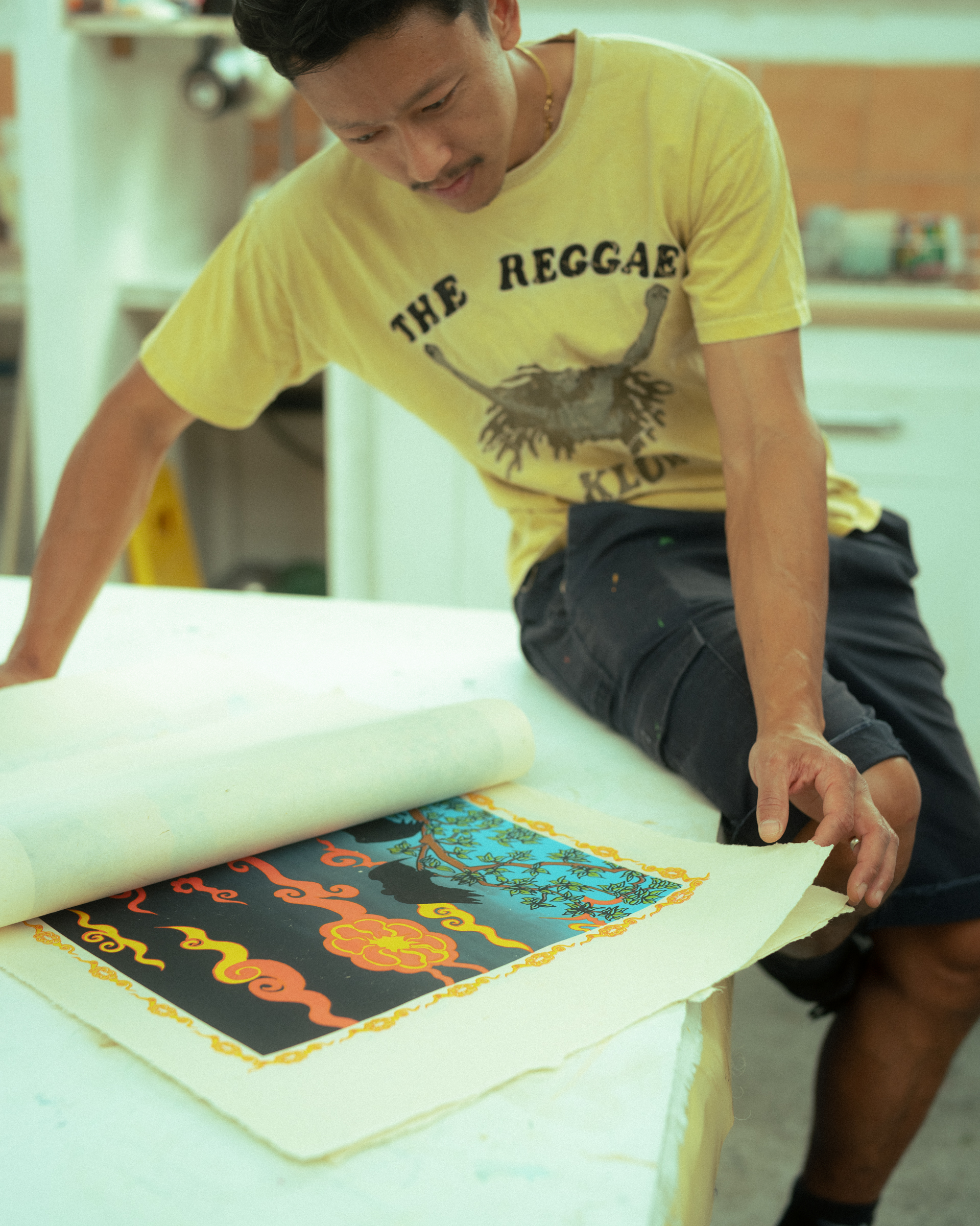
Artist Gaurab Thakali at work in the studio.
You worked closely with Year 10 students at Oasis Academy Silvertown. What stood out to you from those sessions?
I found them very engaging and driven in the way they interacted with the Thames Barrier Park. The drawings and prints they developed during the workshop were of very high standard and inspiring to me. As collaborations go, I definitely picked up on lots of little details they referenced within their drawings that I found intriguing. For example, their use of colours when blending the skyline and plants, as well as drawing on the interesting architecture and patterns they recorded vividly in their work.
For many of those students, it was a rare opportunity to create work outside the classroom. Why do opportunities like that matter?
I think being outside in nature is always a good experience for all of us. More importantly drawing from life outside is one of the most important ways to develop your drawing skills and ability as an artist. Interacting with the subject matter hands on can have a lasting influence in their development as artists. I had a lot of experiences like this growing up as a student and I was very compelled to include this idea as a workshop for them.
You also ran workshops with local residents and UEL students. How have their ideas and input influenced the final design?
Their work during the workshop was also equally outstanding. It was important to have workshops with a wide range of age groups to understand their thoughts and process regarding the mural project. Again they also picked up on various details within the park that were very interesting for me to look through.
Most of them were quite experienced artists when it came to drawing and painting. I found their experimental approach to mono-printing very compelling, for example one of the attendees dissected a drawing of a flower they had created for the first part of the workshop and focussed on shape, abstracting them to the point where it resulted in a pattern like finish during the mono-printing workshop. This in turn has inspired me to create patterns within the mural using a similar technique.
The project explores themes of belonging, community and inclusion. What do those ideas mean to you in the context of the Royal Docks?
Being part of the community is hugely important to me as a migrant to the UK, I was lucky enough to find it as a teenager in this local area. A sense of belonging and inclusion in our local community means being in a safe space as well as being there for each other during good and hard times. I feel there is a strong community in this particular area evident through all the gatherings and their effort to be inclusive to everyone regardless of their race, age, gender, sexuality etc.
I would like to make people feel represented within the artwork, something they can cherish, and that can brighten up their day when they walk past.
When the mural launches in September, what do you hope people who use the park every day will feel when they see it?
As an artist creating a mural for the community, my role is to create something that everyone can have a meaningful connection with. I would like to make people feel represented within the artwork, something they can cherish, and that can brighten up their day when they walk past.
Find out more
To find out more about the Thames Barrier Park mural project and explore more of Gaurab’s work.